
This post may contain affiliate links. If you click on one of my affiliate links and make a purchase, I may receive a commission for referring you. This in no way affects your price. Please know that I only recommend resources and items I believe in and highly recommend. You can read my full disclosure statement here.
How Much Time Does Homeschooling Really Take?

Why trying to replicate a 6-hour public school schedule at home leads to burnout—and what focused seat time actually looks like by grade level.
One of the biggest hurdles new homeschool parents face is overcoming the “classroom standard.” When transitioning from traditional schooling, it is completely natural to assume that formal learning requires sitting at a desk from 8:00 AM to 3:00 PM. However, attempts to enforce a six-hour desk schedule at home almost always lead to unnecessary stress, friction, and burnout.
In a traditional classroom setting, a vast majority of the day is absorbed by administrative management: taking attendance, managing line transitions, handing out materials, addressing behavioral disruptions, and pacing instruction to meet thirty students at once. In a 1-on-1 or small family environment, learning is exponentially more efficient.
The Golden Rule of Homeschooling: Dedicated “sit-down” time is only a fraction of learning. True education includes life skills, outdoor exploration, independent reading, dynamic projects, and meaningful family conversation.
1. Sit-Down Time Expectations by Grade Level
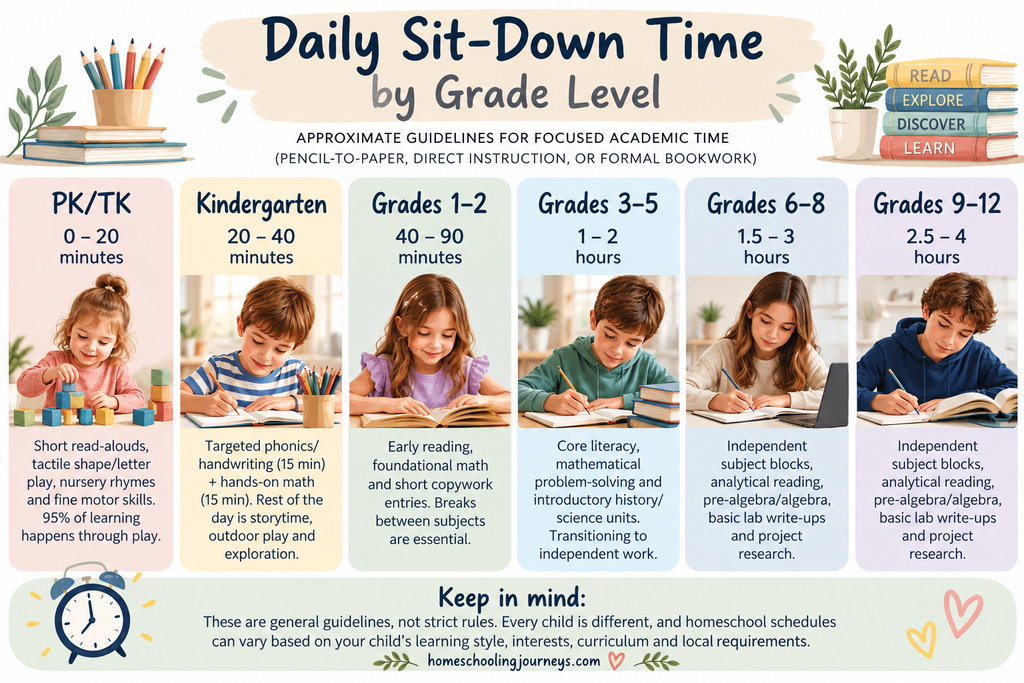
Focused academic time—meaning pencil-to-paper, direct instruction, or formal bookwork—scales gradually as a child develops cognitive stamina:
| Grade Level | Daily Sit-Down Time Target | Focus & Learning Structure |
| PK/TK | 0 – 20 Minutes | Short read-alouds, tactile shape/letter play, nursery rhymes, fine motor skills. 95% of learning happens through play. |
| Kindergarten | 20 – 40 Minutes | Targeted phonics/handwriting (15 min) + hands-on math (15 min). Rest of the day is storytime, outdoor play, and exploration. |
| Grades 1-2 | 40 – 90 Minutes | Early reading, foundational math, and short copywork entries. Breaks between subjects are essential. |
| Grades 3-5 | 1 – 2 Hours | Core literacy, mathematical problem-solving, and introductory history/science content units. Transitioning to independent work. |
| Grades 6-8 | 1.5 – 3 Hours | Independent subject blocks, analytical reading, pre-algebra/algebra, basic lab write-ups, and project research. |
| Grades 9-12 | 2.5 – 4 Hours | Independent subject blocks, analytical reading, pre-algebra/algebra, basic lab write-ups, and project research. |
2. What Counts as Homeschooling Outside of Desk Work?

If high schoolers only need 2.5 to 4 hours of sit-down time, how do you fulfill complete academic credit hours? Formal seat time is only one pillar of an education. Non-desk activities that build real academic value include:
- Independent Reading: Devouring literature, non-fiction guides, or historical fiction outside of direct instruction hours.
- Life Skills & Household Economics: Meal planning, grocery budgeting, culinary practice, household management, and project planning.
- Applied Science & Nature Integration: Gardening, nature journaling, observing ecological systems, or simple kitchen chemistry.
- Interest-Driven Electives: Coding, digital design, history rabbit holes, or entrepreneurship projects.
3. Managing Multiple Grades Without Losing Your Mind

If you are homeschooling children across multiple developmental tiers, do not try to teach everyone simultaneously at the desk. Use a Staggered Focus Rhythm:
- Start high schoolers or middle schoolers on independent reading, morning slides, or assignment logs at 9:00 AM.
- Spend 20–30 focused minutes delivering direct instruction to early elementary learners while older kids work independently.
- Transition younger children to sensory or outdoor play once their short sit-down window finishes.
- Use the late morning block to assist older students with complex subjects, lab analysis, or writing reviews.
4. How to Transition from Public School Mindset to Flow
- Stop Clock-Watching: Focus on completion and mastery rather than filling an artificial time block. If math takes 20 focused minutes instead of an hour, celebrate the efficiency and move on.
- Batch Direct Instruction: Give direct teaching in concentrated 15-to-30-minute bursts, then let students execute tasks independently.
- Trust the Process: Giving your children back hours of their day for free play, creative hobbies, and rest is not a shortcoming—it is the greatest gift of home education.
The Key Takeaway: Quality Over Quantity
Transitioning away from the institutional public school clock is often the single most liberating step in a family’s homeschool journey. When you shift your focus from filling a fixed six-hour block to protecting targeted sit-down windows, education becomes remarkably efficient, joyful, and sustainable.
- Respect Cognitive Stamina: Honoring the developmental seat-time limits—from 20 minutes in Kindergarten to 4 hours in High School—prevents burnout and builds genuine academic focus.
- Count the Whole Day: Learning is never confined to a desk. Nature study, life skills, independent reading, and creative projects complete a rich education.
- Let the Routine Serve You: Use these guidelines as a flexible framework rather than a rigid rulebook, adjusting the rhythm to fit your family’s unique energy.
Once you hit your sit-down goals for the day, put the pencils away, step outside, and trust the process!
Leave a Reply